
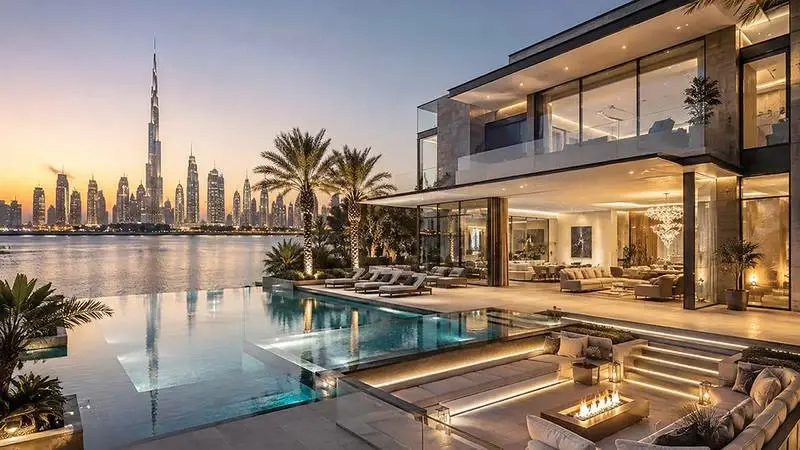
Dubai’s ultra-prime residential market has evolved into a premier global haven for institutional capital and wealth preservation. Driven by record transactions above AED 36.7 million (US$10 million), prime waterfront developments, and favorable regulatory frameworks, international family offices and UHNWIs are allocating long-term capital to secure scarce real estate assets.
The global landscape for private capital allocation has undergone a structural transformation over recent years. Ultra-high-net-worth individuals (UHNWIs), international family offices, and institutional investors are increasingly prioritizing capital preservation, political neutrality, regulatory stability, and inflation-hedged asset classes. Within this macroeconomic environment, Dubai luxury real estate investment has transitioned from a high-yield speculative play into a globally recognized institutional safe haven. The emirate’s residential market, particularly its ultra-prime segment comprising properties valued above AED 36.7 million (approximately US$10 million), has established new global benchmarks for transaction volume, capital appreciation, and cross-border capital absorption.
This research feature analyzes the structural drivers behind the expansion of the Dubai ultra-prime property market. By examining verified transaction datasets from the Dubai Land Department (DLD) and independent global property market reports, this article evaluates how off-plan luxury developments, iconic waterfront master communities, favorable fiscal policies, and sophisticated legal frameworks position Dubai real estate as a primary vehicle for long-term wealth preservation and intergenerational portfolio diversification.
The Expansion of Dubai’s Ultra-Prime Residential Market
The ultra-prime segment of Dubai’s real estate market has experienced exponential expansion over the past five years. Historical data highlights that in 2020, Dubai recorded just 30 residential sales above the US.
$10 million (AED 36.7 million) threshold. By the end of full-year 2025, that metric reached a historic high of 500 transactions exceeding US$10 million, representing a 1,567% increase in volume over the five-year period. In transaction value terms, sales of homes priced at US$10 million or higher generated over US$9.05 billion in 2025 alone, reflecting a 27.7% year-on-year increase in value compared to 2024. Furthermore, super-prime transactions valued at US$25 million (AED 91.75 million) or more surged by 45% year-on-year in 2025 to reach 68 completed deals.
This sustained trajectory allowed Dubai to maintain the top position globally for US 10 million
$10 million-plus home sales for five consecutive quarters throughout 2025, surpassing traditional luxury hubs such as London, New York, Hong Kong, and Los Angeles. DLD transaction data reveals that overall market volume across all price tiers reached a record AED 686.8 billion in total property sales in 2025. A total of 35,932 property transactions in 2025 crossed the US$1 million (AED 3.67 million) mark, confirming that capital depth in the city extends far beyond isolated luxury purchases.
Moving into 2026, market metrics reflect a transitioning market structure characterized by rising completion rates and increased asset holding periods among wealthy owners. Independent market research for Q2 2026 recorded 864 residential transactions above AED 10 million, reflecting a quarterly moderation in high-end deal volume as total market handovers reached a multi-year quarterly high of 27,300 units. Rather than signaling a contraction in demand, this moderation aligns with structural market reclassifications of Dubai as an emerged market, where speculative flipping gives way to long-term asset accumulation by wealthy end-users. Prime residential capital appreciation across ten key luxury communities recorded a 20.4% annual gain in 2025, bringing cumulative capital appreciation for prime properties to 194% since Q4 2020.
Off-Plan Luxury Developments and Waterfront Master Communities
A primary growth engine for high-end real estate investment in Dubai is the primary off-plan sector. Off-plan luxury developments have accounted for 75% to 80% of primary market activity in recent reporting periods, driven by innovative architectural concepts, ultra-luxury branded partnerships, and flexible payment structures tied to construction milestones. Ultra-luxury off-plan property investment in Dubai allows international investors to lock in capital allocation in highly scarce locations before physical completion, frequently capturing initial equity build-up during the development cycle.
Branded residences have emerged as a dominant subclass within the primary market. Industry sector figures indicate that Dubai leads the global branded residence sector, with branded primary sales expanding by 26% in volume and 51% in total transaction value year-on-year. Branded developments command an average price premium of 64% over unbranded comparable units in similar micro-locations. The entry of global luxury hospitality, automotive, and fashion brands into project design provides ultra-luxury properties in Dubai with built-in international recognition, standardized property management, and enhanced liquidity upon resale.
However, off-plan acquisitions require careful institutional evaluation. Key considerations for family offices and private investors include developer delivery track records, construction milestone verification, escrow account regulations under Law No. (8) of 2007, and post-handover service charge projections. While off-plan luxury projects provide attractive capital appreciation potential, ready properties in established communities offer immediate cash-flow generation through long-term leases, avoiding construction delay risk.
Micro-Market Analysis: Palm Jumeirah, Palm Jebel Ali, and Business Bay
The performance of Dubai luxury real estate investment is tightly correlated with micro-location scarcity, waterfront proximity, and infrastructure quality. Investors must distinguish between established luxury districts, newly launched expansion corridors, and high-density commercial-residential hubs.
Palm Jumeirah
As Dubai's original luxury waterfront icon, Palm Jumeirah remains the benchmark for prime villa and penthouse valuations. Verified transaction figures show that Palm Jumeirah alone generated 34% of all prime residential transactions in Q3 2025. The average price for prime properties on the island reached AED 3,767 per square foot in 2025, marking an 8.4% year-on-year increase and a 124% gain since pre-2021 baselines. Notably, transaction volume on the Palm contracted by 19% in late 2025, not due to declining interest, but because luxury homeowners are holding assets for personal use and long-term wealth storage rather than exiting into the secondary market.
Palm Jebel Ali
Twice the land mass of Palm Jumeirah, Palm Jebel Ali represents the next major growth corridor for super-prime waterfront real estate in Dubai. The master development by Nakheel focuses on low-density, highly exclusive beach fronds catering to UHNWIs seeking sprawling plots and customized architectural footprints. In Q4 2025 alone, Palm Jebel Ali recorded 22 individual sales exceeding the US$10 million mark. It appeals primarily to long-term capital seeking multi-year land appreciation and private estate construction.
Business Bay
Historically recognized as a commercial district, Business Bay has transformed into an exclusive center for ultra-luxury, high-rise residential architecture along the Dubai Water Canal. The canal front has attracted flagship branded residence developments, headlined by record-setting transactions such as the Q4 2025 sale of a penthouse in Bugatti Residences by Binghatti for USD 149.7 million (AED 550 million). Business Bay offers high-net-worth property investors in Dubai proximity to Financial Centre (DIFC) and Downtown Dubai, combining capital appreciation potential with competitive rental returns.
Why Family Offices and Foreign Capital Choose Dubai
The sustained influx of foreign capital into the Dubai property market is anchored by systemic economic, legal, and fiscal fundamentals rather than short-term market momentum.
From a fiscal perspective, the UAE maintains an investor-friendly regime with zero personal income tax, zero capital gains tax, zero holding taxes, and zero withholding taxes on property transactions. The UAE Dirham (AED) remains pegged to the US Dollar at a fixed rate of 3.6725, eliminating currency risk for dollar-denominated international investors and cross-border family office portfolios.
Dubai’s regulatory environment provides transparent property rights governed by the Dubai Land Department and the Real Estate Regulatory Authority (RERA). Ownership in designated freehold areas grants unconditional, fee-simple title to foreign nationals. For international family offices managing intergenerational assets, the establishment of common-law legal jurisdictions within Dubai—specifically the Dubai International Financial Centre (DIFC)—enables the integration of real estate into private family foundations, trusts, and corporate holding vehicles with specialized inheritance and succession planning protections.
Furthermore, immigration incentives have directly stimulated end-user demand. The UAE Golden Visa program grants a renewable 10-year residency visa to investors purchasing real estate valued at AED 2 million (US$545,000) or more, with options extending to off-plan properties using approved bank financing or developer payment plans. Coupled with world-class aviation infrastructure via Dubai International Airport (DXB), high levels of personal safety, and political stability, the city has solidified its status as a primary global residence for international business owners and entrepreneurs.
Wealth Preservation, Asset Allocation, and Comparative Global Value
Integrating prime real estate into a global investment portfolio serves as a core strategy for capital preservation, inflation hedging, and asset diversification. Real estate assets in prime locations possess intrinsic physical value, finite supply characteristics, and protection against paper currency debasement.
Despite significant appreciation over recent years, Dubai prime real estate continues to present a compelling relative value proposition when evaluated against alternative global gateway cities. Market benchmarking data indicates that as of late 2025, average prime residential property prices in Dubai stood at approximately US$1,026 per square foot.
As demonstrated in comparative global research, prime luxury space in Dubai costs roughly one-half to one-third of equivalent prime residential space in London, Singapore, or Hong Kong. This price discrepancy allows foreign investors to acquire higher-specification real estate, larger land footprints, and superior lifestyle amenities for equivalent capital outlays.
Additionally, Dubai’s residential rental market provides attractive income characteristics. Gross residential yields across prime communities average between 6.0% and 6.6%, outperforming typical prime rental yields of 2.0% to 3.5% observed in European and East Asian capitals. For ultra-high-net-worth investors, combining steady net rental yields with potential capital appreciation creates an effective defensive asset class during periods of global financial volatility.
Risk Analysis and Strategic Investor Due Diligence
While the fundamentals supporting Dubai ultra-prime real estate investment remain strong, prudent investors must evaluate structural market risks and operational variables before deploying capital.
Market cyclicality remains an inherent feature of global real estate. Supply pipelines represent a critical variable to monitor; pipeline projections indicate that approximately 120,000 to 160,000 residential units are scheduled across all price tiers in Dubai over the 2026–2027 horizon. While the ultra-prime segment above AED 36.7 million benefits from natural geographic land scarcity in prime coastal zones, high completion volumes in mid-market suburban districts can induce localized price stabilization or rental yield compression.
Investors must also account for transaction and holding friction costs. Purchasing real estate in Dubai incurs a 4% Dubai Land Department transfer fee, a 2% agency commission (+ VAT), trustee registration fees, and ongoing annual service charges levied per square foot of property area. In super-prime price tiers (US$25 million+), asset liquidity is naturally constrained compared to mid-market apartments. Investors acquiring trophy assets should structure holdings with a five- to ten-year investment horizon to optimize exit valuations and avoid forced liquidations during broader market adjustments.
Strategic Outlook for Ultra-Prime Real Estate Investors
The long-term outlook for Dubai’s ultra-prime residential sector remains grounded in structural economic maturing rather than short-term speculation. The market has shifted from a transaction volume-led expansion phase into an value-preservation phase characterized by end-user occupation, wealth consolidation, and institutional governance.
To maximize long-term outcomes, high-net-worth property investors in Dubai and international family offices should focus on three strategic principles:
Prioritize Location Scarcity: Concentrate capital in supply-constrained micro-markets—such as established fronds on Palm Jumeirah, prime waterfront plots in Palm Jebel Ali, and low-density luxury golf estates—where future competing supply cannot dilute land values.
Execute Strict Developer Due Diligence: When purchasing primary off-plan luxury property, evaluate developers based on historical delivery speed, financial solvency, escrow compliance, and post-completion facility management quality.
Align Holdings with Governance Structures: Structure property purchases through DIFC foundations or corporate entities to seamlessly combine asset ownership with family wealth transfer, tax efficiency, and legal protection.
Through disciplined selection, rigorous data verification, and alignment with established regulatory frameworks, global investors can leverage Dubai luxury real estate investment as an effective foundation for international capital preservation and long-term portfolio growth.
AED 686.8 billion total property market value in 2025 (+30.9% YoY); 35,932 property transactions exceeding US$1 million (AED 3.67M) in 2025; AED 425 million record villa sale in Emirates Hills.
For detailed market analysis, tailored investment structuring, or guidance on allocating your capital in Dubai’s real estate market, contact the specialist team at Bay Point.