
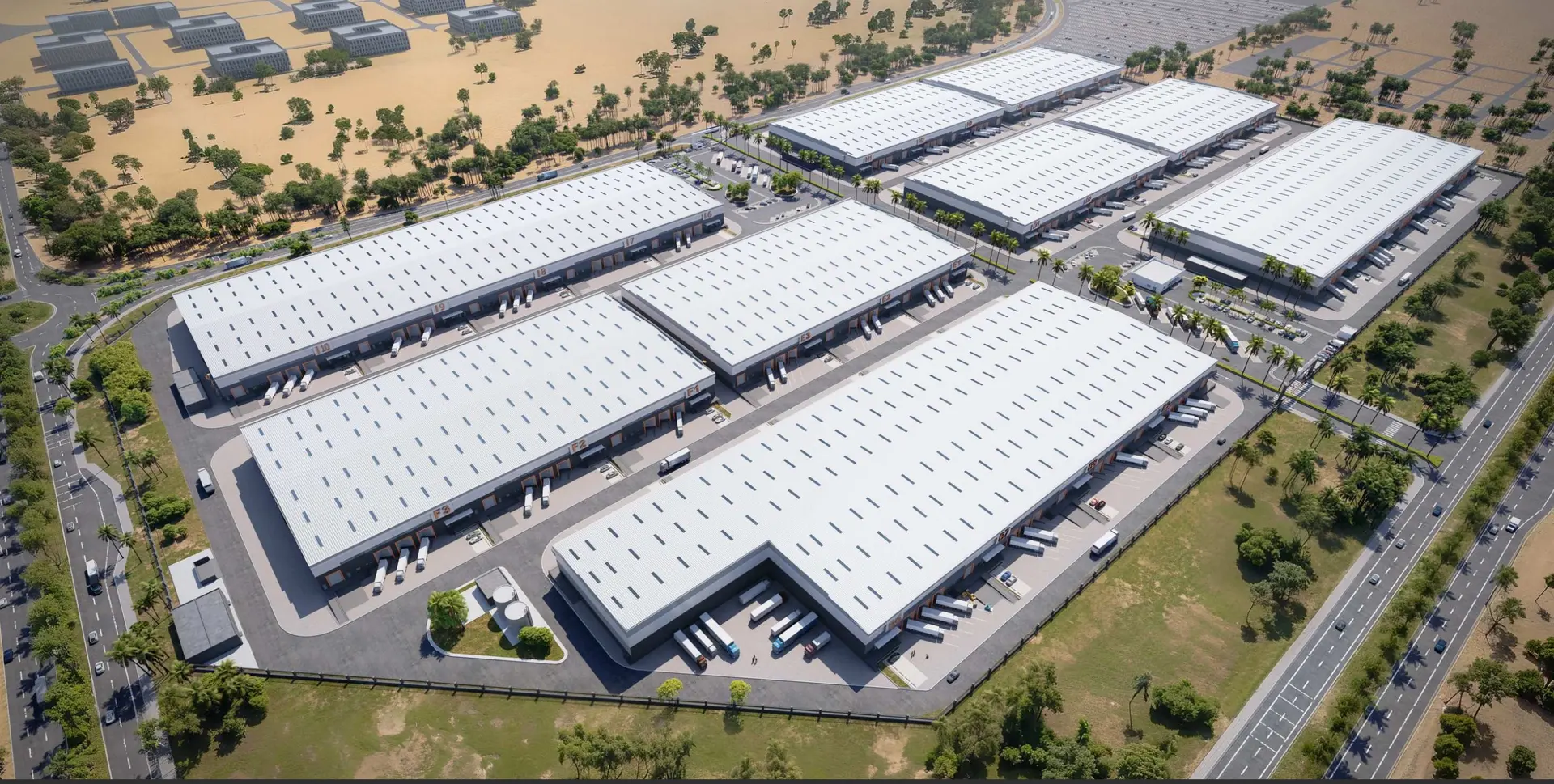
Explore the ultimate guide to buying and investing in Dubai industrial real estate. Discover warehouse specifications, DEWA power requirements, locations, and market trends.
The Dubai industrial real estate sector is currently experiencing unprecedented demand, cementing the emirate’s position as a premier global logistics hub. Driven by the rapid expansion of e-commerce, regional food security initiatives, and transformative infrastructure projects like the Etihad Rail network, the industrial property market has become one of the most lucrative and defensible asset classes in the Middle East. Dubai stands at the center of global trade, with its world-class ports, free zones, and air freight facilities making it an essential node for international supply chains.
As of late 2026, the market has absorbed over 12.3 million square feet of new industrial requirements. This massive surge in demand has pushed Grade A warehouse occupancy to a staggering 95%, simultaneously driving year-on-year rental growth as high as 37.8% in prime logistics corridors. For business owners seeking a commercial warehouse for sale in Dubai, or international investors looking to capitalize on this boom, the focus has shifted from simple storage to complex warehouse optimization. Understanding the technical specifications, strict regulatory landscape, and zonal dynamics is absolutely critical before committing capital.
1. Market Hubs, Zoning, and Ownership Structures
When considering a Dubai warehouse investment, the first critical decision an investor must make involves land tenure and location. Dubai’s industrial real estate operates predominantly on a leasehold model, which differs significantly from residential property markets. Understanding these ownership structures is vital for long-term financial modeling.
The vast majority of industrial land in free zones (such as JAFZA and Dubai South) and mainland hubs (like Al Quoz and Dubai Industrial City) is leased from the government or a master developer on long-term structures. These leasehold agreements typically range from 15 to 50, and sometimes up to 99 years. Ground rents are paid annually to the master developer. This structure provides 100% business ownership for foreign investors in free zones and offers long-term security that is fully recognized and registered by the Dubai Land Department. While outright freehold industrial plots—where the investor owns the land indefinitely—do exist in select designated mixed-use areas, they are exceedingly rare in Dubai, carry a significant price premium, and are highly contested when they enter the market.
Choosing the right location depends entirely on the permitted activities and zoning of the logistics property in Dubai. Different industries naturally cluster in specific zones based on infrastructure, connectivity, and customs requirements. JAFZA (Jebel Ali Free Zone) remains the primary hub for large-scale manufacturing, pharmaceutical consolidation, and global logistics, offering bonded environments that allow operators to store and re-export goods without triggering mainland customs duties. Dubai South is rapidly expanding as the preferred destination for air-freight-dependent cargo and e-commerce, offering direct proximity to Al Maktoum International Airport.
For heavy manufacturing, food processing, and large-scale distribution, Dubai Industrial City (DIC) and National Industries Park (NIP) offer the heavy utility infrastructure required. Conversely, areas like Al Quoz and Dubai Investment Park (DIP) are highly sought-after for micro-fulfillment centers (MFCs), last-mile retail delivery, and temperature-controlled warehousing due to their immediate proximity to urban residential centers and major highways like the E311 and E611.
2. Structural Specifications and Civil Engineering
A warehouse property in Dubai is evaluated strictly on its technical specifications and physical capabilities. Modern logistics operators prioritize operational efficiency, safety, and cubic volume over mere square footage. When evaluating these heavy structural demands, investors often rely closely on a construction engineer to assess the feasibility of the asset, especially if considering a retrofit of an older building.
Modern Grade A facilities require a minimum clear ceiling height of 8 to 14 meters. However, e-commerce operators and automated warehouses are increasingly pushing this requirement to 15 meters or more to accommodate high-density vertical racking systems. Maximizing vertical space is a key strategy for warehouse optimization, allowing businesses to store more inventory without increasing their expensive ground footprint.
Floor loading capacity is equally critical. A standard general storage facility may only require a floor load capacity of 2 to 3 tons per square meter. However, facilities intended for heavy manufacturing, dense vertical racking, or Automated Storage and Retrieval Systems (AS/RS) require heavily reinforced concrete flooring capable of handling 3 to 5+ tons per square meter without cracking or subsiding.
Furthermore, access and loading specifications dictate how fast goods can move in and out of the facility. High-volume logistics properties must feature raised loading docks equipped with automated, sealed dock levelers. These levelers facilitate seamless and safe forklift movement between the truck trailer and the warehouse floor. For temperature-sensitive goods, these loading bays must be pre-cooled to ensure cargo is never exposed to ambient Dubai temperatures. The external plot must also be carefully designed to accommodate the turning radius of heavy articulated trucks, which can be up to 18 to 20 meters. Ample staging and parking areas are required to prevent trucks from queuing on public roads, which is a direct violation of Dubai Municipality regulations.
3. Demystifying Warehouse Electrical and Power Requirements
Perhaps the most critical, yet frequently underestimated, aspect of buying an industrial warehouse in Dubai is the electrical capacity. The available power limit directly dictates what a facility can be used for. Investors must never assume a generic electrical load applies to all warehouses. Electrical requirements are highly variable and are dictated by the warehouse's intended use, machinery, refrigeration systems, HVAC, lighting, and automation.
Industrial equipment relies on a three-phase power supply, which is typically 400V in the UAE. Unlike standard residential single-phase power, three-phase electricity provides the stable, heavy-duty, and continuous current required to run industrial HVAC compressors, conveyor belts, and manufacturing machinery without overloading the circuits. When evaluating power, it is important to understand that DEWA (Dubai Electricity and Water Authority) typically provisions industrial connections based on connected load calculations measured in kilowatts (kW), representing the actual power consumed, while the total power drawn from the grid is measured in kilovolt-amperes (kVA).
While exact electrical capacity must always be calculated by a DEWA-approved electrical engineering consultant based on a tenant's specific equipment, there are realistic industry ranges that investors can use as a baseline for a standard 10,000 sq. ft. (approx. 1,000 sqm) facility:
General Storage Warehouses (20 kW – 40 kW):
These facilities are used for storing non-perishable goods such as furniture, dry building materials, or garments. The power is primarily needed for standard LED high-bay lighting, basic ventilation fans, security systems, and small administrative office spaces.
Logistics and Distribution Warehouses (50 kW – 90 kW):
These active facilities require significantly more power to operate electric forklift charging stations, mechanized dock levelers, enhanced industrial ventilation, and larger IT infrastructures required for modern Warehouse Management Systems (WMS).
E-Commerce and Automated Warehouses (100 kW – 150+ kW):
The power demand here is heavy and continuous. These facilities require robust electrical infrastructure to run miles of conveyor systems, robotic sorting lines, continuous server loads, and substantial HVAC systems to maintain a comfortable environment for a large workforce operating around the clock.
Cold Storage and Pharmaceutical Warehouses (200 kW – 350+ kW):
Temperature-controlled facilities have massive power requirements. Maintaining deep freeze (-20°C) or cold chain (2°C to 8°C) environments requires heavy-duty three-phase compressors running continuous cooling cycles. Furthermore, these facilities require mandatory backup redundancy, such as N+1 generators and Uninterruptible Power Supply (UPS) systems, to prevent a catastrophic loss of inventory during a grid fluctuation.
Manufacturing and Industrial Warehouses (300 kW – 1,000+ kW):
Power needs in this sector are highly variable and extreme. Heavy manufacturing, such as plastics molding, metal fabrication, or pharmaceutical cleanrooms, requires immense, dedicated electrical substations to run high-heat processes and heavy industrial machinery safely.
Upgrading a property's power capacity after purchase can be exceptionally expensive, time-consuming, and is always subject to DEWA network availability in that specific neighborhood. Therefore, securing a property with adequate existing power is a major driver of commercial real estate value.
4. Fire, Life Safety, and Regulatory Compliance
A commercial warehouse cannot legally operate in Dubai without passing stringent audits and securing operational permits. The Dubai Civil Defence (DCD) mandates rigorous fire and life-safety compliance.
While standard storage properties may utilize traditional hose reels and basic sprinkler networks, Grade A logistics properties are expected to feature Early Suppression Fast Response (ESFR) sprinkler systems. These high-volume systems are specifically designed to extinguish fires in high-rack storage configurations rapidly. Furthermore, Dubai regulations mandate strict fire compartmentalization, using fire-rated partitions to prevent the spread of smoke and flames. For large cubic-volume spaces, mechanical smoke extraction systems are a mandatory life-safety requirement to ensure clear evacuation routes during an emergency.
Beyond fire safety, the Dubai Municipality (DM) heavily regulates structural blueprints, plot coverage limits, hygiene standards, and waste management. Buyers must ensure that any mezzanine floors, office expansions, or structural modifications made by previous tenants were legally permitted; otherwise, the new owner inherits the liability and the cost of rectification.
5. The Boom in Cold Storage and Pharmaceutical Logistics
The cold storage and pharmaceutical logistics sector currently represents one of the most defensible and high-growth pockets for industrial property investment in Dubai. Driven by proactive national food security initiatives and stricter regulatory standards for medical supplies, the UAE cold chain logistics segment is estimated at approximately USD 1.83 billion in 2026 and is projected to reach USD 2.43 billion by 2031.
Because upgrading a standard dry warehouse to a fully compliant cold storage facility requires complex MEP engineering and heavy capital expenditure, existing facilities with the correct infrastructure command significant rental premiums and exceptional tenant retention. These facilities require precise climate zoning, often dividing a building into Controlled Room Temperature (15°C–25°C) and Cold Chain (2°C–8°C) zones.
Furthermore, pharmaceutical warehouses must meet stringent facility design and operational standards set by the Ministry of Health and Prevention (MOHAP) and the Dubai Health Authority (DHA). They must adhere to global Good Distribution Practice (GDP) guidelines, utilizing continuous IoT-enabled environmental monitoring and specialized HEPA filtration to maintain cleanroom standards.
6. Financial Viability and Investment ROI
When analyzing warehouse investment opportunities in Dubai, commercial real estate investors must carefully balance projected yields against required capital expenditures.
Industrial properties in Dubai typically offer highly attractive net rental yields, often ranging between 7% and 9%, which generally outpaces standard residential real estate returns. Industrial tenants also favor long-term leases, frequently signing contracts for 3 to 10 years, which provides investors with stable, predictable cash flow and low vacancy risks. Tenant stickiness is particularly high in specialized sectors; once a manufacturing or cold storage operator invests heavily in custom fit-outs and secures all municipal approvals, relocating becomes highly disruptive and cost-prohibitive.
However, investors must carefully underwrite the risks. The age of the asset is a critical factor. Older warehouses may require costly upgrades to meet updated DCD fire codes or may lack the electrical capacity required to attract modern, automated tenants. Thorough technical due diligence is non-negotiable before finalizing any purchase.
7. The Future of Dubai's Industrial Sector
The future of warehousing in Dubai is defined by the integration of physical efficiency with digital intelligence. As labor costs rise and delivery timelines compress, logistics operators are transitioning rapidly toward automation and data-driven decision-making.
Future demand is highly concentrated on Smart Warehouses equipped with IoT sensors that monitor inventory temperature and movement in real time, autonomous forklifts, and AI-driven predictive analytics that forecast demand. Additionally, ESG (Environmental, Social, and Governance) compliance is transitioning from a corporate buzzword to a baseline requirement for multinational tenants. Facilities that feature solar-powered operations, energy-efficient HVAC zoning, and sustainable waste reduction initiatives will continue to command the highest market valuations and attract the highest-quality operators in the years to come.
Frequently Asked Questions (FAQ)
Which type of warehouse is most common in the UAE?
Steel-based, pre-engineered buildings (PEB) are the most prevalent type of warehouse in the UAE. They are highly favored for their durability, scalability, lack of interior supporting columns (which maximizes usable floor space), and rapid construction timelines.
Can a foreign investor buy a warehouse in Dubai?
Yes. Foreign corporate entities and individual investors can acquire leasehold rights (typically ranging from 15 to 99 years) in designated industrial free zones and mainland areas. Full outright freehold purchases are restricted to very specific, designated mixed-use zones.
Why is three-phase electricity important for warehouses?
Three-phase electricity provides a consistent, high-density power supply that is absolutely necessary to safely start and run large industrial motors, heavy HVAC chillers, and continuous manufacturing equipment. Standard single-phase power cannot support industrial-scale machinery without severe voltage drops or circuit overloads.
What is the difference between a bonded and non-bonded warehouse?
A bonded warehouse, generally located within a recognized free zone like JAFZA or Dubai South, allows importers to store, process, and re-export goods internationally without immediately paying UAE mainland customs duties. Non-bonded mainland warehouses are used for goods that have already cleared customs for local distribution.
Are automated warehouses worth the initial capital investment?
While automated systems require a substantial upfront financial commitment, they drastically maximize cubic space utilization, reduce long-term dependency on manual labor, minimize costly handling errors, and accelerate order throughput. For high-volume e-commerce and retail businesses, this results in a highly favorable long-term return on investment.
Dubai Land Department (DLD): Referenced to establish the foundational legal frameworks distinguishing leasehold and freehold commercial real estate ownership structures within the Emirate of Dubai.
Dubai Electricity and Water Authority (DEWA): Used to verify the technical framework of industrial electrical distribution (distinguishing between kW and kVA) and to confirm the necessity of DEWA-approved electrical consultants for calculating specific industrial load provisions.
Dubai Civil Defence (DCD): Referenced for mandatory commercial fire and life-safety compliance protocols, specifically the utilization of ESFR sprinkler systems, fire compartmentalization, and mechanical smoke extraction.
Dubai Municipality (DM): Referenced for structural planning mandates, facility hygiene, plot coverage limits, and regulations regarding heavy vehicle staging to prevent public road congestion.
Ministry of Health and Prevention (MOHAP) & Dubai Health Authority (DHA): Referenced for the stringent regulatory compliance parameters required for pharmaceutical storage, including adherence to global Good Distribution Practice (GDP) standards.
Industry Market Data (Synthesized): Absorption rates (12.3 million sq. ft.), occupancy figures (95%), rental growth rates (37.8%), and the UAE cold chain logistics financial valuations (USD 1.83B to 2.43B) were utilized directly from the provided commercial real estate research notes to frame the 2026 market context.