
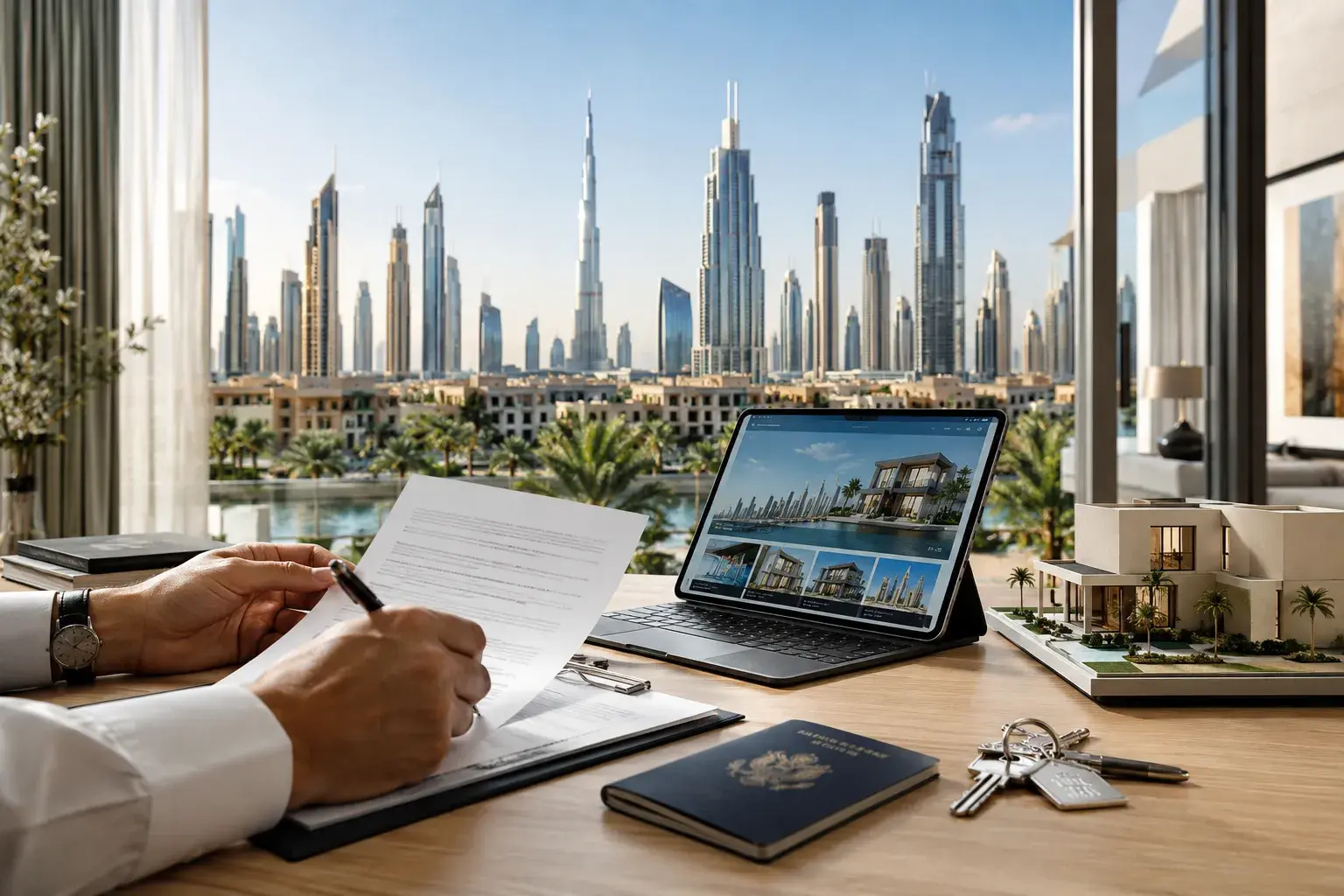
Investing in Dubai real estate from overseas requires understanding legal protections, registration, and payment procedures. This guide covers RERA and DLD safeguards, off-plan escrow accounts, POA, Form F, 2026 bank requirements, and key closing costs such as the 4% DLD fee. It also highlights developer checks, red flags, and currency considerations to help international buyers invest securely.
Navigating the Dubai real estate market from overseas requires a clear understanding of legal safeguards, financial frameworks, and procedural compliance. This article provides a comprehensive guide for foreign investors, outlining how Dubai protects capital through RERA regulation, official Dubai Land Department (DLD) registration, and strictly monitored off-plan escrow accounts. Key operational steps—including Securing Power of Attorney (POA), acquiring Form F via the Dubai REST app, and managing mandatory bank account matchings under 2026 regulations—are detailed alongside an itemized breakdown of closing costs (such as the 4% DLD fee). By highlighting red flags, developer vetting, and exchange rate considerations, this guide serves as an essential manual for international buyers seeking secure, long-term property investments in the UAE.
In today’s market, buying property in Dubai from abroad is no longer a rare move. It has become part of how investors think, especially when they are looking for stability outside their home country. You can access listings easily, the process is clear, and decisions can be made from anywhere. Still, one concern does not go away so easily. What actually protects your money when you are not physically there to see it happen? That question matters more now, as global conditions feel unclear, and timing is difficult to judge. Dubai does offer a system that supports overseas buyers, but confidence does not come from that alone. It comes from knowing how each step works and where you need to slow down. Before moving ahead, it helps to understand what really keeps your money secure and what you should never overlook.
Key Takeaways
Escrow Protection: Dubai's regulated escrow system ties developer payments directly to verified construction milestones.
Official Ownership Tracking: All real estate ownership in Dubai is central and legally recorded through the Dubai Land Department (DLD).
Document Standard: Ready property buyers receive an official Title Deed, while off-plan buyers receive an Oqood certificate during the construction phase.
Mandatory Checks: A valid RERA license for your real estate agent and confirmed escrow account details are the two critical checks required before any monetary transfer.
Currency Stability: The UAE dirham’s peg to the US dollar offers financial predictability, though currency exchange fluctuations can alter final costs for non-USD buyers.
Why Do Overseas Buyers Continue to Choose Dubai?
Any buyer you speak to now shows a clear shift. People are not chasing quick wins. They are looking for something they can rely on. Dubai makes that easier to understand. Ownership rules are clear, the process follows a proper system, and everything connects back to official authorities. It helps reduce uncertainty, especially when you are buying property in Dubai while living in another country. Interest in properties for sale in Dubai continues to grow, reflected in steady market activity. In March 2026, over 10,000 transactions were recorded, with apartments accounting for around 81% of the total. Activity continues across a wide range of budgets, with buyers actively entering the market.
Income is the other part of the story. Many buyers are not planning to move in straight away. They want the property to generate returns while they hold it. Smaller units continue to see steady demand, with approximately 3,500 one-bedroom, 2,200 two-bedroom, and 2,000 studio transactions recorded, reflecting consistent buyer activity across these segments. The conversation has also become more practical. Renewals, rental competition, and cheque flexibility now play a bigger role in decision-making, as they impact income stability. This points to a market view for investors where long-term returns matter more than quick resale gains.
Your First Step Starts Before the Payment
Most buyers think risk begins when money is transferred, but it usually starts much earlier, when trust is formed. A listing looks right, the price feels reasonable, and the agent sounds confident, which can make everything feel easy. A quick pause here can help. Ask yourself one simple question, “Who am I dealing with?”
Agents in Dubai must hold a valid RERA license. You can ask for their broker number and verify it yourself. A leading real estate company will not hesitate to share details, and you will notice a clear process and proper communication, without any pressure to rush. When answers feel unclear or incomplete, it is better to step back. Trust is built through transparency, not speed.
The Dubai Property Buying Process for Overseas Buyers
Buying from another country can feel complicated, but the process in Dubai follows a fixed structure. Each step has a clear purpose and order.
Step 1: Know what you can buy
You do not need a UAE visa or a local sponsor to buy property in Dubai. Foreign nationals of any nationality can buy freehold property in Dubai's designated zones. You only need a valid passport and must be at least 21 years old.
Only freehold areas are open to foreign buyers, covering over 40 zones
Popular zones include Dubai Marina, Palm Jumeirah, Downtown Dubai, and Business Bay
Studio apartments in affordable areas start from approximately AED 400,000 to 500,000
Step 2: Sort your budget first
Before you look at any property, know exactly how much you can spend.
If you need a mortgage, get approval from a UAE bank before you start your search
Non-residents can get a mortgage, but the loan amount is usually 50% to 75% of the property value, so a large deposit is needed
UAE banks that offer mortgages to non-residents include Emirates NBD, Mashreq Bank, and HSBC
Add 7 to 9% on top of the property price to cover all additional fees
Step 3: Set up a Power of Attorney (POA)
Since you are abroad, you need someone in Dubai to act on your behalf. This is done through a Power of Attorney.
The POA must be written in Arabic, stamped by the UAE Embassy in your country, and approved by the UAE Ministry of Foreign Affairs
Confirm the POA is notarised in your home country first, then attested by the UAE Embassy, and finally approved by the UAE Ministry of Foreign Affairs. Each step must happen in that order
The POA must be less than two years old at the time of the property transfer
Step 4: Work with a RERA-licensed agent
Your agent must hold a valid RERA license. Ask for their broker number and check it yourself on the RERA website.
A licensed agent will handle listings, negotiations, and all paperwork on your behalf
A good agent will share listings that match your budget, give you regular updates, and guide you from contract to handover
Many developers also offer virtual tours and mock-up units so you can view the property remotely
Step 5: Sign the sales agreement (Form F)
Once a price is agreed, both parties sign the formal sales agreement, known as Form F or the Memorandum of Understanding (MOU).
A 10% deposit is paid by the buyer at this stage
Form F must be signed digitally through the Dubai REST app, as paper copies are no longer accepted
If you are abroad, your POA representative can sign on your behalf
Step 6: Get the No Objection Certificate (NOC)
The seller obtains a letter from the developer confirming that there are no outstanding fees on the property.
This is called the NOC, and it confirms the property has no outstanding service charges or obligations
Fees for this letter vary by developer and usually fall between AED 500 and AED 5,000
This process takes a minimum of three to five working days
Step 7: Complete the transfer
The final step is the official transfer at a DLD-approved trustee office. Your POA representative attends on your behalf.
Your representative must bring the original passport, signed Form F, the NOC, and manager's cheques for the balance and DLD fees
Under 2026 rules, all money from the sale must go into a UAE bank account held in the exact name on the title deed. Third-party accounts are no longer allowed.
Your name on your passport, title deed, and bank account must all match exactly
Step 8: Receive your ownership document
For a ready property, you receive an electronic title deed by email, usually within one to three working days after the transfer
For an off-plan property, you receive an Oqood certificate first, which converts to a title deed once construction is complete
What Will It Cost You?
DLD Fee: 4% of the property price goes to the Dubai Land Department as a transfer fee
Trustee Fee: The trustee's office fee is around AED 4,000
Agency Fee: Agent commission is typically 2% of the property price
Taxation: Dubai has no annual property tax
Service Charges: Service charges are paid annually by the owner after the purchase is complete
How Long Does It Take?
Ready Properties: Takes two to six weeks from signing the agreement to receiving the title deed
Off-Plan Properties: Follows the construction timeline, which is usually one to four years until handover
How Dubai Keeps Buyer Payments Secure
A common concern for overseas buyers is what happens after the payment is made. Many assume the developer gets full access right away, but that is not how the system works in Dubai. For off-plan properties, payments are placed into regulated escrow accounts tied to each project. These accounts are monitored, and funds are released to the developer in stages based on actual construction progress. This creates a level of control that protects buyers during the build phase and keeps the process tied to real progress on site.
What to check before you transfer funds:
Confirm the project is registered with the authorities
Ask for official escrow account details
Match the account name with the developer’s name
Avoid sending money to personal or third-party accounts
Taking a few minutes to verify these points can prevent issues later and give you clarity on where your money is held.
How Ownership Is Recorded in Dubai
Paperwork may not be the most exciting part of buying a property, but it is what formally confirms your ownership. The type of document you receive depends on whether the property is ready or still under construction, and understanding that difference helps avoid confusion later on.
Ready Property: You receive a Title Deed, which serves as final ownership proof issued after the official transfer.
Off-Plan Property: You receive an Oqood Certificate, which represents initial registration while the project is under construction.
For ready units, the title deed issued by the Dubai Land Department confirms that the property is officially in your name. For off-plan purchases, the Oqood certificate shows that your unit has been registered even before completion. Some buyers feel unsure when they do not receive a title deed immediately, but that is a normal part of the process. Registration secures your position. Once construction is complete, the ownership record is transferred to a title deed.
Why the Developer Behind the Project Matters
The developer you choose plays a major role in shaping your experience, from how smoothly the project progresses to the quality you receive at handover. Some developers have years of delivery history across different communities, while others are still building their track record. Names like Emaar Properties, DAMAC Properties, and Nakheel are widely recognised because of their large-scale developments, which give buyers a level of familiarity, but recognition alone should not guide your decision. Looking at past delivery timelines, construction quality, and feedback from existing owners provides a clearer picture and helps avoid situations where a project looks appealing at first but does not meet expectations later.
Why Structured Payments Protect You
A safe transaction in Dubai usually follows a clear, predictable structure, which gives buyers confidence. Off-plan properties are designed around staged payment plans, where you make an initial booking amount and continue payments as construction progresses. It keeps the process aligned with actual progress rather than upfront commitments. Ready properties work differently, where payments are completed during the transfer stage at an authorised trustee office, which adds another layer of oversight. In a market where rising buyer demand week-on-week is being noticed, it can sometimes feel like decisions need to be made quickly, but pressure to transfer large amounts early should always be taken seriously. Slowing down and following the proper steps is what keeps your money protected.
Why Registration Should Never Be Skipped
Every property transaction in Dubai connects back to one central system where legal ownership is recorded and verified. The Dubai Land Department handles registration, maintains ownership records, and oversees the entire transaction process. Buyers can also use official channels to check project details and confirm ownership information before moving forward. A deal that is not registered through this system has no legal standing, which is why this step carries so much weight. It also plays a role in selling in today's market, because buyers expect clear ownership records and proper documentation before making any decision.
How Currency Changes Can Impact Your Purchase
Money safety is not only about avoiding risk during the transaction, but it also includes understanding how external factors can affect your overall cost. The UAE dirham is linked to the US dollar, which provides stability, but buyers using other currencies may still notice changes depending on global exchange movements. Some prefer to transfer funds in stages to manage timing, while others work with currency specialists to secure better rates than those offered by standard bank transfers. Even a small shift in exchange value can make a noticeable difference when applied to property amounts, which is why timing and planning play a quiet but important role in the overall purchase.
What Are the Warning Signs to Watch For?
Some risks are easy to spot when you know where to look. Early action can prevent serious trouble later. A deal may look good on the surface, but small details often reveal whether something is off. Taking a step back in these moments is not hesitation but a protection.
Watch out for these warning signs:
Being asked to transfer money outside official or verified accounts
An agent avoiding sharing license details or rushing past verification
Prices that feel far below the general market range without a clear reason
Pressure to make quick decisions without proper documents in place
Incomplete or unclear paperwork during the early stages of the deal
Not every situation will lead to a problem, but ignoring these signs can. A careful pause at the right time can save you from decisions that are difficult to undo.
Conclusion
Buying property from abroad always carries a degree of uncertainty when you rely on people and processes from a distance. But Dubai offers a system that supports safe transactions when followed correctly. The real difference comes from your approach. Check details, know where your money goes, and confirm all documents. When you stay patient and avoid rushing into decisions, the process becomes far more manageable, and what initially feels uncertain starts to feel structured and under control.
Buying from abroad shouldn’t feel uncertain. Get the clarity you need before you commit. Speak with a Bay Point expert consultant today.
Frequently Asked Questions
Can foreigners legally buy property in Dubai?
Foreign buyers can purchase property in approved freehold areas where ownership rights are fully recognised and recorded by the authorities.
Is it safe to transfer money for property from another country?
Transfers are secure when sent to verified accounts linked to registered projects and supported by official documentation.
What protects buyers during off-plan purchases in Dubai?
Payments are controlled through project-linked accounts and released only when construction reaches specific approved stages.
What is a title deed in Dubai?
A title deed is an official ownership document issued after transfer, confirming that the property is registered under the buyer’s name.
What is the risk of dealing with unlicensed agents?
Unlicensed agents operate outside the regulatory framework, increasing the risk of unclear transactions and a lack of legal protection.
How do I check a developer’s background?
Review completed projects, delivery timelines, and buyer feedback to understand the developer’s track record.