
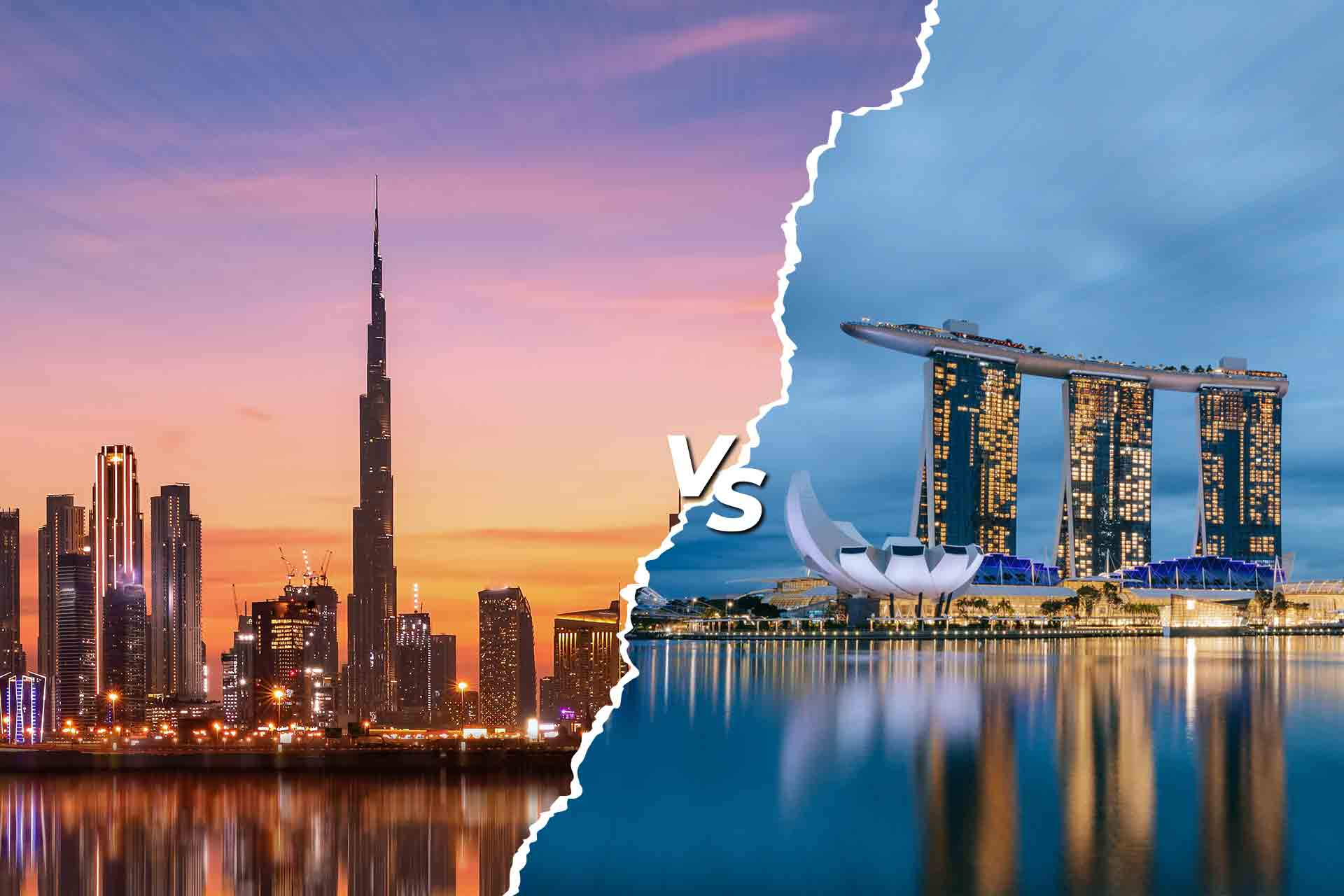
Dubai and Singapore have competed for the attention of global real estate investors for a decade — both are internationally recognised city-states with strong governance, rule of law and expat populations. But the two markets have diverged dramatically on accessibility, yields and investor friendliness. This analysis gives investors the full picture.
Two Global City-States: The Competition for Investor Capital
For a decade, Dubai and Singapore have competed as Asia-Pacific and Middle East anchor cities for global mobile capital. Both offer stability, rule of law, international connectivity, tax efficiency and cosmopolitan expat communities. But the comparison today is dramatically tilted in Dubai's favour — particularly following Singapore's extraordinary Additional Buyer's Stamp Duty (ABSD) increases that have priced most foreign investors out of the Singaporean market.
The Purchase Cost Differential: The Most Important Difference
Singapore's government has repeatedly increased ABSD to cool foreign investor demand:
- Singapore ABSD for foreign buyers: 60% of purchase price (as of 2023) — this effectively prohibits most foreign real estate investment
- Singapore ABSD for permanent residents (2nd property): 30%
- Singapore ABSD for Singapore citizens (2nd property): 20%
Compared to Dubai:
- Dubai DLD Transfer Fee: 4% of purchase price — for all buyers, regardless of nationality or number of properties
- Dubai agent commission: 2%
- Total Dubai buying cost: ~6-7% for any buyer
This is perhaps the starkest single comparison in global real estate: buying a SGD 3 million Singapore condo as a foreign investor costs SGD 1.8 million in stamp duty alone. The equivalent Dubai property costs AED 240,000 in DLD fees. The policy difference is transformational for investor capital allocation.
Rental Yield Comparison
| Property Type | Dubai Gross Yield | Singapore Gross Yield |
|---|---|---|
| Studio/1-bedroom | 7-10% | 2.5-3.5% |
| 2-bedroom apartment | 5-8% | 2-3% |
| 3-bedroom+ | 4-6% | 1.5-2.5% |
Dubai's yield advantage over Singapore is approximately 3-5 percentage points — compounded over a 10-year investment horizon, this difference in income return alone justifies a significant valuation premium for Dubai assets.
Tax Environment Comparison
| Tax Category | Dubai | Singapore |
|---|---|---|
| Annual property tax | Zero | Property Tax (4-20% of annual value) |
| Capital gains tax | Zero | Zero (on residential property) |
| Rental income tax | Zero (individuals) | 17% corporate / personal rate |
| ABSD (foreign buyer) | Zero (no equivalent) | 60% |
Market Scale and Liquidity
Singapore has a deeply liquid, transparent real estate market — but the ABSD has dramatically reduced transaction volumes and foreign participation. The private residential market is dominated by Singaporean citizens and permanent residents, with foreigners restricted to a very small portion of activity.
Dubai has seen record transaction volumes in 2023-2024, with foreign buyers comprising 65-70% of residential transactions. This international diversity provides exceptional market depth and liquidity — more buyers in the market means faster sales and better price discovery.
Governance and Rule of Law
Both cities score exceptionally on governance quality, rule of law and property rights protection:
- Singapore: Ranked #1-3 globally on most governance metrics. Common law system, independent judiciary, extremely low corruption. Property rights are among the world's most secure.
- Dubai/UAE: Ranked #25-30 globally but improving rapidly. DIFC has its own common law courts that provide internationally trusted dispute resolution for financial and commercial matters. Property rights for foreigners in freehold zones are legally robust and well-tested.
Quality of Life: Where to Actually Live?
Both cities offer exceptional quality of life:
- Singapore offers superior public transport, greener urban environment, safer streets and arguably better social infrastructure (public housing system, healthcare)
- Dubai offers significantly lower cost of living relative to equivalent lifestyle, more living space per dollar, 12 months of outdoor enjoyment (weather excluding summer), and the Middle East's premier lifestyle destination credentials
The Investment Verdict
For pure real estate investment return, Dubai wins comprehensively: higher yields, lower purchase costs, no annual property tax, and no capital gains tax. Singapore's 60% ABSD for foreign buyers has effectively closed that market to most international investors — the return math simply doesn't work at those stamp duty levels.
For those who also want to live there long-term and for whom lifestyle quality is the primary consideration, Singapore remains an exceptional global city. But for property investment return maximisation, Dubai is the clear choice in this comparison.