
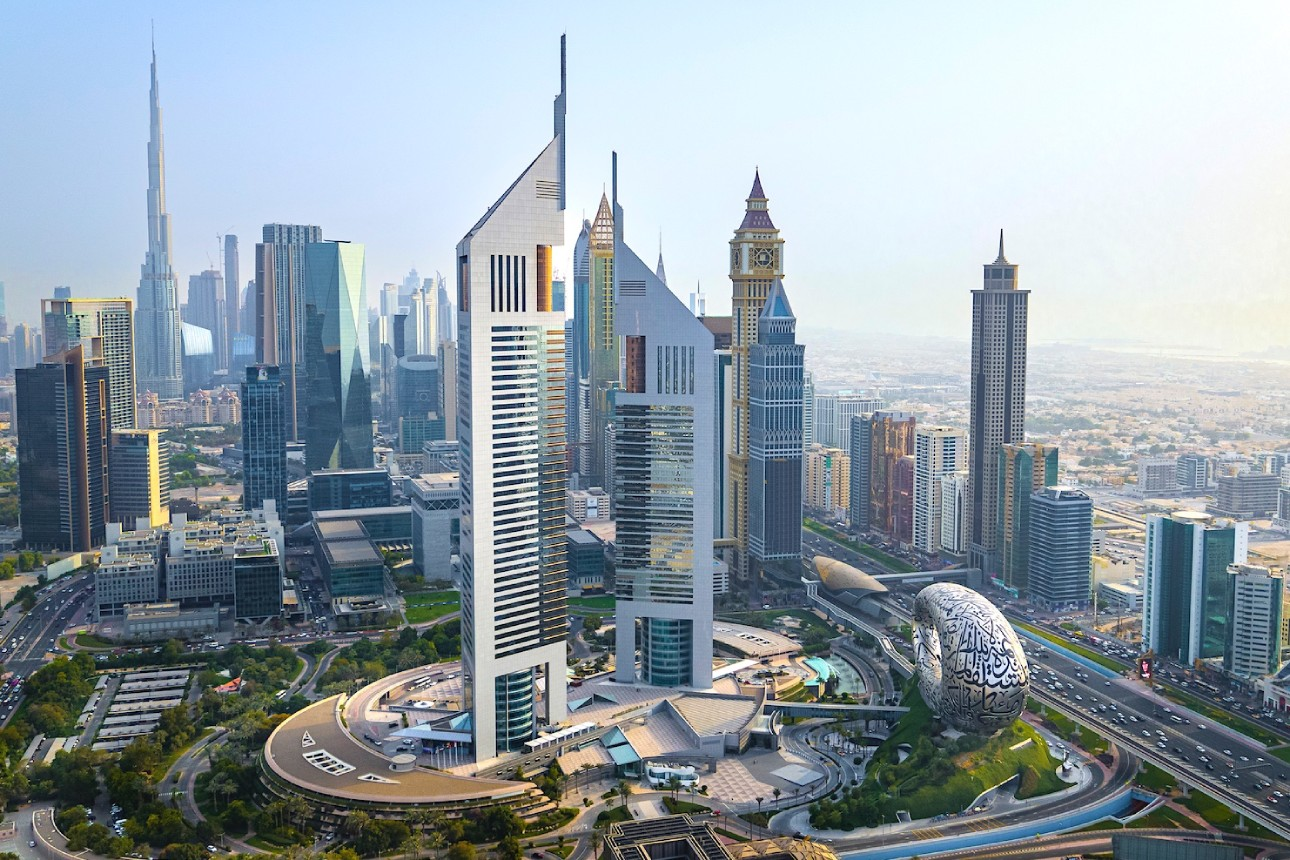
After years of exceptional performance, where is the Dubai property market headed? Our 5-year forecast analyses population growth, supply pipeline, key economic drivers and the transformational infrastructure investments that will shape Dubai's real estate landscape through 2030.
Dubai's Real Estate Market: Current State
Dubai's property market in 2026 is operating from a position of remarkable strength. Transaction volumes in 2024 exceeded AED 450 billion — a record for the emirate — while residential prices in prime communities have risen 40-80% since the 2021 recovery began. The market has attracted significant international capital from Europe (particularly post-Brexit UK buyers), Russia, India, China and the wider MENA region.
Average residential property values now sit at AED 1,400-1,600 per square foot in prime areas, with some ultra-premium communities (Palm Jumeirah, Emaar Beachfront, Downtown) trading above AED 3,000 per square foot. The question every investor is asking: how much further can prices run, and what are the catalysts and risks over the next five years?
The Population Engine: Dubai's Biggest Growth Driver
The single most important macro driver of Dubai real estate demand is population growth. Dubai's population has grown from 3.3 million in 2020 to an estimated 3.8 million in 2026, and the emirate's ambitious D33 (Dubai Economic Agenda) targets a population of 5.8 million by 2040 — a 53% increase from today's level.
This growth will require an additional 500,000-700,000 residential units over the period — a massive and sustained demand driver that underpins long-term property market strength. New residents (particularly the high-income professionals Dubai is attracting through its talent visa and golden visa programmes) disproportionately rent before buying, creating sustained rental demand alongside sales demand.
Key Demand Drivers 2026-2030
Al Maktoum International Airport Expansion
The single largest infrastructure catalyst for Dubai real estate over the next decade is the planned expansion of Al Maktoum International Airport in Dubai South. With an announced investment of AED 128 billion and a capacity target of 260 million passengers annually (four times Heathrow's current capacity), the new airport will be the world's largest when complete. Its development is already catalysing significant investment in Dubai South real estate, and the construction phase alone will bring hundreds of thousands of workers and professionals to the area.
Wynn Resort (Expected 2027)
While technically in Ras Al Khaimah, the UAE's first integrated resort with gaming facilities (announced by Wynn Resorts for Marjan Island) will have nationwide implications. Dubai-based investors are already pricing in increased tourism demand from global high-net-worth visitors who use Dubai as their arrival hub and staging point.
Financial Services Growth
The Dubai International Financial Centre has seen application volumes from global financial institutions grow by 40% since 2022. Major relocations including hedge funds, family offices and private equity firms bring high-income professionals who become premium residential tenants and buyers. DIFC's planned expansion will double its footprint by 2030.
Crypto and Tech Sector
Dubai has positioned itself as a global hub for the digital assets and technology sector, with VARA (Virtual Assets Regulatory Authority) providing the world's first comprehensive crypto regulatory framework. This has attracted crypto wealth and tech entrepreneurs who are significant property buyers — particularly in the premium segments.
Supply Pipeline: The Key Risk to Monitor
Dubai's off-plan launch volumes in 2023-2024 reached historic highs, with over 100,000 units launched for sale across the emirate. This supply pipeline will begin delivering completions in significant volumes from 2026-2028. The critical question is whether demand growth — driven by population expansion — will absorb this supply without significant price softening.
Analysis of historical Dubai cycles suggests that sustained population growth above 3% annually — which Dubai has delivered in recent years — can absorb even elevated supply volumes without meaningful price declines. However, any significant slowdown in population growth (driven by global economic shocks, regional instability or major supply-demand imbalances) would create headwinds.
Price Forecast by Segment 2026-2030
Ultra-Premium (AED 3M+ properties)
Forecast: +15-25% cumulative by 2030
Palm Jumeirah villas, Downtown penthouses and Emaar Beachfront apartments are constrained by genuine supply scarcity. New ultra-premium supply is being absorbed rapidly by UHNW buyers. This segment is likely to continue outperforming the broader market, though at a decelerating pace from 2023-2024 highs.
Premium (AED 1.5-3M)
Forecast: +12-20% cumulative by 2030
Dubai Marina, Business Bay canal-front, Dubai Hills Estate villas and Sobha Hartland properties remain well-positioned. International buyer demand is growing and supply in genuine waterfront locations is limited. Moderate outperformance of the broader market expected.
Mid-Market (AED 600K-1.5M)
Forecast: +8-15% cumulative by 2030
The largest segment by volume, and the one most exposed to supply pipeline risk. Communities like JVC, Business Bay non-waterfront, JLT and Al Furjan will see continued demand from Dubai's growing professional workforce but face more competition from new supply. Yields in this segment remain strong, providing income return even if capital growth moderates.
Affordable (Below AED 600K)
Forecast: +5-10% cumulative by 2030
International City, Discovery Gardens, Deira and similar communities serve a critical worker housing need but face ongoing supply additions and low barriers to entry. Capital appreciation will be modest; yield is the primary return driver.
Scenario Analysis
Bull Case (Probability: 35%)
Al Maktoum Airport construction accelerates, generating massive employment and residential demand in Dubai South and surrounding areas. Global capital continues flowing into Dubai as a safe haven. Premium residential prices increase 20-35% by 2030. Yields remain stable at 6-8%.
Base Case (Probability: 50%)
Dubai population grows at 3-4% annually. Supply pipeline is absorbed without major disruption. Premium properties appreciate 10-15% by 2030, mid-market delivers 5-10%, affordable delivers 3-6%. Yields compress slightly but remain attractive at 5-7%.
Bear Case (Probability: 15%)
A global recession reduces international capital flows to Dubai. Off-plan delivery surge creates temporary oversupply in the 2026-2028 window. Price corrections of 10-20% from 2026 peaks in mid-market communities. Premium and waterfront communities prove more resilient. Recovery begins by 2028-2029.
Investment Strategy for 2026-2030
Given this outlook, our recommendations for investors over the 2026-2030 horizon:
- Prioritise location: Waterfront, metro-connected and branded properties will outperform through any cycle
- Diversify by segment: Blend yield-focused mid-market with capital-growth premium properties
- Consider off-plan selectively: Best launches from top developers still offer attractive entry pricing — but be selective about developer quality
- Hold for 5+ years: The 5-year horizon absorbs any near-term volatility and captures the full D33 growth cycle
- Use rental income as a buffer: Strong yields provide downside protection — even if capital values soften, 7% annual yield compounds significantly over five years