
Discover the 8 major UAE infrastructure, tech, and tourism projects—including the Dubai Gold Metro Line and Palm Jebel Ali—driving real estate investment and economic growth.
The UAE’s next phase of development is pivoting toward long-term economic resilience, led by eight multi-billion-dollar mega-projects across transport, artificial intelligence, finance, tourism, and waterfront real estate.
For property investors, this pipeline is a roadmap. These developments dictate where residents will move, where global businesses will set up, and where real estate values are projected to compound over the next decade. Priority is currently heavily weighted toward infrastructure and technology-led initiatives that support logistics, trade, and a knowledge-based economy.
Here is a breakdown of the eight projects redefining the UAE’s investment landscape, categorized by their market impact.
1. Connectivity & Logistics: The Mobility Revolution
Transport infrastructure is a proven catalyst for real estate appreciation. New transit nodes historically drive demand, increase rental yields, and create entirely new economic corridors.
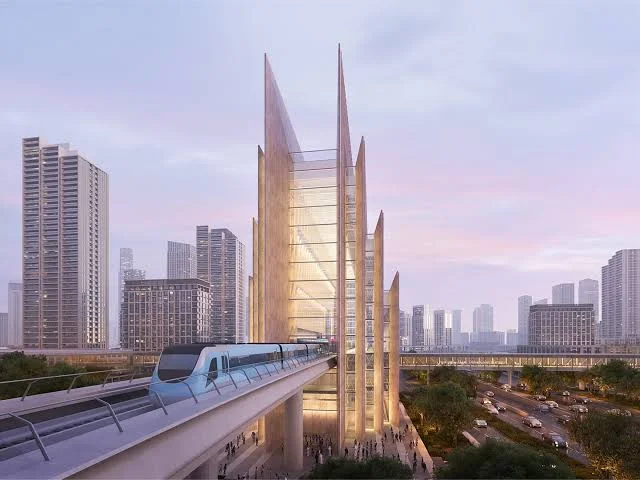
Dubai Gold Metro Line: Approved as a monumental AED 34 billion ($9.2 billion) infrastructure leap, this fully underground 42-kilometre network will connect 15 key areas and 1.5 million residents by 2032. Crucially, it links existing metro lines with Etihad Rail. For investors, the Gold Line is a massive catalyst for transit-linked communities, heavily supporting demand around future station areas.
Etihad Rail: This 900-kilometre national railway network connects all seven emirates and links to the wider GCC. Capable of replacing 300 trucks per train and cutting emissions by 80%, it drastically reduces transport costs and bolsters industrial growth. Real estate investment patterns are already shifting toward future transport-linked locations, logistics hubs, and industrial zones surrounding the rail network.
2. Financial & Tech Powerhouses: The Capital Gateways
To sustain high-value foreign direct investment (FDI), the UAE is aggressively expanding its financial and technological footprints, creating prime demand for commercial real estate and high-income residential housing.
DIFC Zabeel District (DIFC 2.0): Expected to more than double the capacity of Dubai’s financial centre, this expansion will support over 42,000 companies and 125,000 professionals. The phased rollout adds millions of square feet of mixed-use commercial, residential, and hospitality space. It is viewed as one of Dubai's most critical growth drivers for the finance and real estate sectors.
Al Maryah Island Expansion: Over in Abu Dhabi, a Dh60 billion-plus masterplan will add 1.5 million square metres of mixed-use space to Al Maryah Island by 2030. Tied closely to the Abu Dhabi Global Market (ADGM), this expansion will drastically increase prime office and residential supply to meet the influx of banks, family offices, and global capital.
Group 42’s Project Stargate: Tech infrastructure is the new real estate. Backed by major US tech giants, the 26-square-kilometre Stargate campus features a massive $40 billion estimated budget. Phase 1 will deliver a 1-gigawatt AI infrastructure cluster by 2030, cementing the UAE as a global leader in AI model training and sovereign data management while driving demand for specialized tech talent housing.
3. Luxury Tourism & Waterfront Living: The Lifestyle Anchors
While infrastructure builds the economy, lifestyle developments drive the UAE's explosive population and visitor growth, heavily supporting the luxury residential and hospitality markets.
Nakheel Palm Jebel Ali: One of Dubai’s most ambitious waterfront masterplans, expanding the coastline by 110 kilometres. Designed to house over 35,000 families alongside 80+ hotels and resorts, it creates a massive new urban growth corridor in Dubai's south. This is a long-term play for ultra-luxury residential demand and long-term land value appreciation.
Wynn Al Marjan Island: Valued at $5.8 billion and slated for 2027, this is the UAE’s first large-scale gaming-led integrated resort. Located in Ras Al Khaimah, it is completely transforming the northern emirate's profile, drawing entirely new tourist demographics and driving fierce demand for nearby hospitality and retail real estate.
Disney Resort Abu Dhabi: An estimated $7 billion family-oriented destination that diversifies Abu Dhabi’s culture-led tourism. This massive entertainment anchor will support the entire tourism value chain, benefiting hotels, retail, and F&B investments in the capital.
Project Completion Timeline
Understanding delivery schedules is vital for timing market entry and capitalizing on off-plan appreciation.
1: Wynn Al Marjan Island
2027
Opening of the $5.8 billion integrated resort in Ras Al Khaimah.
2: Nakheel Palm Jebel Ali
2028 - 2030
Initial phased deliveries of the massive waterfront expansion housing 35,000 families
3: Al Maryah Island Expansion
2029 - 2030
Addition of 1.5 million square metres of mixed-use space to Abu Dhabi's financial hub.
4: Group 42 Project Stargate (Phase 1)
2029 - 2030
Delivery of the 1-gigawatt AI infrastructure cluster.
5: Disney Resort Abu Dhabi
~2030
Expected opening of the $7 billion family entertainment destination.
6: Dubai Gold Metro Line
2032
Completion of the 42-kilometre underground transit network.
7: DIFC Zabeel District
2030 - 2040 (Phased)
Long-term, multi-phase expansion doubling Dubai's financial centre capacity.
Etihad Rail
Ongoing (Phased)
Continuous rollout of the 900-kilometre national passenger and freight network.
The Investor Takeaway
The key to capitalizing on these mega-projects is matching supply with demonstrated demand. Aligning your investment strategy with these future hubs—whether it’s a transit-linked apartment on the Gold Line or a luxury villa on Palm Jebel Ali—allows you to secure entry prices before the infrastructure is fully priced into the market.
Analyze the Gold line ROI
Most industry analyses and real estate reports currently forecast a 15% to 25% price premium for properties located within the "Gold Line corridor" compared to similar non-connected units, with some studies suggesting potential appreciation of up to 20% specifically tied to metro-proximate developments by the project's completion.
In Dubai’s real estate market, infrastructure-led value appreciation typically follows a proven lifecycle. Investors generally categorize value uplift into three distinct phases:
The Announcement & Route Clarity Phase: (Current) Developers and early investors identify high-potential plots. We are currently seeing land valuations shift as developers prioritize land parcels near planned station nodes.
The Construction Phase: This is often where the most significant "off-plan" capital appreciation occurs. As transit stations take physical shape, the risk premium decreases, and demand from end-users and long-term investors intensifies.
The Operational Launch Phase: Once the line is active, properties benefit from structural rental yield increases and lower vacancy rates. Historical data shows that properties within 500–800 meters of metro stations consistently command higher liquidity and rental premiums compared to car-dependent counterparts.
Investor Takeaway
If you are looking at the Gold Line for capital appreciation, focus on transit-oriented developments—areas designed for high-density, mixed-use living. These communities are specifically engineered to leverage the metro’s ridership, ensuring that rental demand remains robust even if broader market conditions fluctuate.
Infrastructure is a "slow-burn" catalyst; the strongest gains are usually realized by those who secure assets during the construction phase (2026–2030) rather than waiting for the line to become operational in 2032.
Compare UAE waterfront properties
For a luxury property investor, choosing between Palm Jebel Ali (PJA) in Dubai and Wynn Al Marjan Island in Ras Al Khaimah (RAK) is not just a choice between two locations—it is a choice between two fundamentally different investment theses.
One is an ultra-luxury capital appreciation play backed by Dubai's mature macroeconomic engine; the other is a high-yield, first-mover entertainment play tapping into an entirely new regional market.
1: Palm Jebel Ali: The Legacy Wealth & Capital Appreciation Play
Palm Jebel Ali is twice the size of the original Palm Jumeirah and represents Dubai’s next frontier for ultra-high-net-worth individuals (UHNWIs). It is a long-term play tailored for wealth preservation and massive capital gains.
The Investment Core: PJA addresses a critical scarcity in Dubai—the severe shortage of premium, private beachfront villas. Look closely at the masterplan layout: it maximizes private beach access for almost every single property, a feature that has driven Palm Jumeirah prices to record highs.
Monetization Strategy: This is primarily a capital appreciation play. Investors buying the initial frond villas or premium plots stand to capture substantial equity growth as Nakheel builds out the infrastructure toward 2028–2030.
Rental Profile: Expect lower, more stable net rental yields (typically 3% to 5%) but highly secure, long-term tenants—often elite families or corporate executives seeking ultra-exclusive, low-density living.
2. Wynn Al Marjan Island: The High-Yield Entertainment Monopoly
Wynn Al Marjan Island is a transformational development driven by a historic regulatory shift: the introduction of the GCC’s first legal gaming-led integrated resort. It is a near-term, cash-flow-heavy play.
The Investment Core: Look at the scale of the resort tower relative to the surrounding island. This development is engineered as a high-density tourist magnet. Luxury investors are targeting the surrounding branded residences and high-end hotel apartments on Al Marjan Island to capture the incoming wave of international visitors.
Monetization Strategy: This is a pure rental yield and short-term liquidity play. Because the resort opens in 2027, the timeline to monetization is much shorter than PJA's. The sheer volume of high-spending tourists, gamers, and corporate events is projected to drive unprecedented short-term rental yields (potentially hitting 8% to 11% net) via holiday home management.
Risk & Reward: Capital appreciation will be rapid in the lead-up to and immediate aftermath of the 2027 opening. However, long-term appreciation will depend heavily on RAK maintaining its exclusive positioning before other regional gaming licenses are potentially issued.